Ball Bounce
- 4.5
- Rating
- 5.00M
- Installs
- Free
- Price

 Analysis by App-foxy
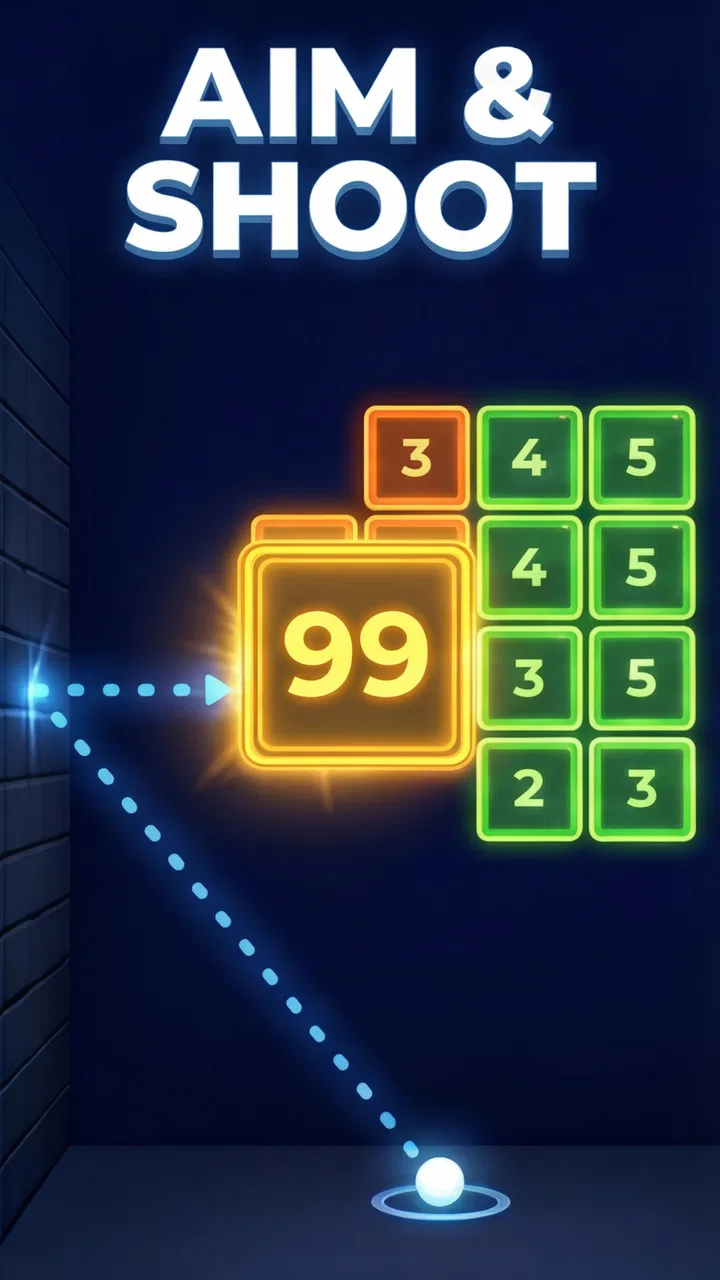
I like casual games that explain themselves in seconds and do not demand a long commitment. Ball Bounce fits that mood immediately: I tap, watch the balls break through brick formations, and decide for myself whether I want one more attempt. That simple loop is the main reason I can imagine keeping it on my phone. It is a game for the small spaces in a day when I want a little activity rather than a story, a competitive ladder, or a complicated set of rules.
Developed by Gimica GmbH, this free casual game is built around aiming, bouncing, and gradually turning a single shot into a much larger chain of impacts. The basic idea is easy to understand, but the satisfaction comes from planning the first direction carefully and then watching the resulting movement unfold. Its strongest quality is short-session clarity: I never need a tutorial-heavy introduction before I can start playing.
Why the first few rounds work so well
The opening experience is pleasantly direct. The game does not need a large explanation to communicate what I should do. Bricks provide the immediate target, balls provide the action, and the bounce gives each shot a little more character than a simple tap-and-clear puzzle. That makes Ball Bounce approachable for someone who normally avoids games with complicated controls.
You May Also Like

 Google Keep - Notes and lists
Google Keep’s Quiet Growth Shows the Appeal of Simpler Notes
As mobile work gets busier, Google Keep keeps winning a simple contest: capture a thought quickly, find it later, and get on with the day.

 Blood Strike: 2.5 Anniversary
Blood Strike’s Loadouts Turn Every Drop Into a Tactical Gamble
A close look at Blood Strike’s custom loadouts: how fast access to signature weapons reshapes its battle royale rhythm, rewards preparation, and narrows the gap between fights.

 Pandora - Music & Podcasts
Pandora’s Music Is Easy to Start, but Harder to Recover
Pandora’s strength is its low-effort path from a seed to a station. Its weak spot is how much confidence it asks you to place in connection, setup, and quiet recovery.

 8 Ball Pool
 Is Built on Rivalries, Rematches, and Routine
A close look at the rivalries, rematches, shared routines, and unanswered safety questions that turn a quick pool match into a persistent mobile community.

 Samsung Music
’s Quiet Strength Is Playing What You Already Own
Its reach comes less from spectacle than from dependable access to a personal library. That simplicity is both the app’s strongest retention engine and its ceiling.

 AccuWeather: Weather Radar
AccuWeather Review: A Quick, Clear Forecast for Everyday Decisions
For everyday plans, the best forecast is the one you can understand quickly. AccuWeather makes rain timing, radar, and local conditions easy to act on, with a few trade-offs.
More From Our News Desk



The appeal is not just that it is easy. The first shot creates a small decision: should I aim at the nearest group, look for an angle that sends balls across a wider area, or try to start a longer sequence from one side? I do not need to calculate everything perfectly, but careless aiming can make the next moments less effective. That small amount of planning gives the game more substance than a purely automatic time-killer.
I also appreciate that the action is readable. When several balls begin moving around the play area, the screen becomes busy, yet the central idea remains understandable. I can usually tell whether a shot was smart because the balls keep finding useful surfaces, or whether I chose an awkward angle that leaves too much work for the next turn. The visual result is rewarding without requiring me to learn a complicated system first.
For an everyday example, I could play while waiting for a coffee, sitting on public transport, or taking a short break between tasks. I would not choose it when I wanted a deep evening game, but I would choose it when I had only a few minutes and wanted something more engaging than scrolling. The game’s casual category is a good fit because it offers an immediate activity without asking me to organize my schedule around it.
The age rating of Everyone also matches the accessible presentation. I can hand the game to a younger family member without first explaining mature themes or an elaborate control scheme. That does not mean every player will enjoy it equally. Someone who needs a strong narrative, character development, or constant novelty may find the straightforward format too narrow.
The rhythm of one shot and the next
Ball Bounce feels best when I treat each turn as a small puzzle rather than as a race. The important moment is often before the balls move, when I look at the available surfaces and consider how the first contact will change the rest of the path. Once the shot begins, much of the pleasure comes from observing whether that choice produces a useful chain.
This creates a comfortable rhythm. I make a decision, watch the result, and then reassess the new situation. The loop is quick enough to keep me involved, but it leaves room for a little anticipation. A good angle can make one shot feel much more productive than expected, while a weak angle reminds me that the game rewards patience more than random tapping.
A practical tip is to avoid focusing only on the closest brick. I get better results when I consider where the ball will travel after the first collision. A direct hit may look attractive, but a route that reaches several surfaces can create a more satisfying sequence. This is one of the game’s less obvious strengths: the simple controls still allow room for better and worse decisions.
Another useful habit is to pause mentally before every launch, even when the board looks easy. Because the action is so accessible, it is tempting to play on autopilot. That usually reduces the strategic part of the experience. Taking a brief moment to inspect the angle makes the game feel more deliberate and helps separate a thoughtful attempt from a throwaway one.
The bouncing action also gives the game a different feel from the usual match-three alternatives. Match-three games often ask me to scan for combinations among individual pieces, while this game asks me to predict movement through space. Traditional endless runners depend more on quick reactions and continuous forward motion. Ball Bounce is calmer than both, although it still gives me a small sense of tension when I am waiting to see whether the shot will clear enough of the formation.
That comparison also reveals a limitation. If I want a wide range of puzzles with very different rules, this may feel less varied than a larger puzzle collection. Its pleasure comes from refining the same basic action, not from constantly introducing new genres of challenge. I see that as a reasonable trade-off for the clean learning curve, but it is important to know before installing it.
Why interruption tolerance matters
Short games are not automatically good break games. Some punish me for leaving, lose the context of a session, or create pressure to continue. Ball Bounce is more suitable for interruptions because its central activity is already divided into compact decisions. I can play a little, put the phone down, and return when I have another spare moment without needing to remember a complicated storyline.
That makes it useful in situations where my attention is uncertain. If a message arrives or I need to switch tasks, I do not feel that I have abandoned a long campaign. The game’s straightforward structure lowers the cost of stopping. For me, this is more important than a large feature list because many casual games are used in fragments rather than in planned sessions.
It also works well when I am mentally tired. I can use the game as a gentle focus reset: aim, watch the movement, and make another small decision. At the same time, it is not completely passive. If I stop thinking about angles, the results become less satisfying. That balance gives it a useful middle ground between a screensaver-like activity and a demanding puzzle.
I would still avoid starting it when I need to concentrate fully on another task. The game is easy to pick up, but the bouncing action is engaging enough to encourage another attempt. A quick break can become longer if I keep chasing a cleaner shot or a more effective sequence. That is not a serious flaw, but it is worth recognizing for anyone trying to use it during work or study.
The current version is 1.4.5, and the game supports Android 7.0 and later. In practical terms, that makes it available to many older Android phones as well as newer devices. I would still judge the experience by how comfortable the screen feels on a particular phone, since games based on aiming and moving objects benefit from a display where targets are easy to read.
Immediate pleasure versus long-term repetition
The first few sessions are the easiest to enjoy because the core loop is instantly understandable. I can see the result of a good choice right away, and that immediate feedback gives even a short attempt a clear beginning and end. The game does not need a long setup before it starts delivering its main pleasure.
The more important question is what keeps me returning after the novelty fades. For me, the answer is the desire to make better decisions with the same basic tools. I can try a safer route, search for a more productive angle, or simply see whether I can handle the next formation more efficiently. That is replay value based on refinement rather than on a large collection of unrelated activities.
This approach will suit players who enjoy repetition with small improvements. It may not suit someone who needs a constant stream of new mechanics to stay interested. I would describe the replay value as focused: the game asks me to revisit its central idea, not to explore a broad world. Whether that feels satisfying depends on how much I enjoy polishing a simple action.
A helpful way to keep the experience fresh is to change the goal of a session. Instead of always trying to clear the board as quickly as possible, I can focus on finding a particularly efficient angle or avoiding careless shots. This self-imposed variation costs nothing and makes the same mechanics feel more intentional. It is especially useful during short breaks, when a small personal challenge gives the session a purpose.
There is also a trade-off between watching a long chain develop and wanting immediate control. The bouncing sequence is enjoyable because it creates anticipation, but I am not directing every moment once the shot is underway. Players who prefer constant input may find that waiting less exciting than the initial aim. Players who like seeing a plan resolve will probably get more pleasure from it.
Free to start, with a point to consider
Ball Bounce is free to download, which makes trying the basic experience easy. Optional in-app purchases range from $0.99 to $3.49 per item. I would approach those purchases as convenience spending rather than as a reason to install the game. The core appeal should come from the bouncing and aiming loop itself; if that loop does not hold my attention, buying extras would not solve the underlying problem.
For a casual player, the sensible approach is to begin without spending and see whether the short-session rhythm fits. I would also avoid treating every difficult moment as a signal that I need to purchase something. The game is more enjoyable when I first improve my aim and understand the board rather than immediately looking for a shortcut.
The free entry point is particularly useful for families or people who only occasionally play mobile games. It lowers the risk of trying something that may turn out to be too repetitive. On the other hand, anyone who dislikes optional purchases in free games should decide in advance whether they are comfortable ignoring them. That simple boundary helps keep a quick break from turning into an unplanned expense.
Who should install it, and who should skip it
I would recommend Ball Bounce to someone who wants an uncomplicated game for waiting rooms, commutes, and short pauses. It is also a good match for players who enjoy light spatial planning but do not want a formal puzzle campaign. The controls are approachable, the objective is easy to understand, and the action can provide a satisfying burst of concentration without a long commitment.
It is less suitable for players searching for a strong narrative, deep progression, or a wide range of modes. I would also suggest skipping it if repeated aiming and bouncing sounds boring after the first few minutes. The game’s identity is clear, and that clarity is both its advantage and its limit. It does not try to become a full-scale adventure or a complex strategy title.
The audience response is encouraging, with a 4.4 average from around 127 thousand ratings and more than 5 million installs. Those figures suggest that the simple format has reached a substantial casual audience, although popularity alone cannot tell me whether its repetition will suit my own habits. I would use the free download as a low-risk test rather than assuming that a widely played game must be right for everyone.
Compared with a match-three game, this offers less board scanning and more anticipation of physical movement. Compared with a runner, it is less frantic and easier to interrupt. Compared with a large physics puzzle game, it is lighter and faster to understand, but also narrower in scope. That position is exactly why I see it as a break-time companion rather than a main game.
My casual verdict after returning to it
Ball Bounce succeeds because it respects the small amount of attention many people actually have for mobile games. I can begin quickly, make a meaningful choice, watch the result, and stop without feeling that I have missed an important story beat. The immediate pleasure comes from turning a simple direction into a chain of bouncing impacts, while the replay value comes from trying to make that direction smarter next time.
Its weaknesses are equally clear. The focused loop may become repetitive, and the game will not satisfy players who need constant novelty or deeper systems. Optional purchases are present, so I would keep my spending boundary in mind. I also would not confuse its easy controls with a guarantee of endless variety; the long-term appeal depends on enjoying small improvements within the same framework.
Still, I think its strengths are well matched to casual use. Gimica GmbH has made a game that is easy to understand without being completely mindless, and that distinction matters. I can recommend it to a friend who wants a free, low-pressure way to fill a few minutes, especially if that friend enjoys watching a plan unfold. For short sessions, easy interruptions, and a modest dose of replayable aiming, Ball Bounce is a worthwhile download.
FAQs for Ball Bounce
01What is Ball Bounce, and how does it work?
Ball Bounce is an addictive arcade game available on both Android and iOS platforms. The objective is to control a bouncing ball through various levels filled with obstacles and challenges. Players must tap the screen to keep the ball bouncing while navigating through intricate paths, collecting bonuses, and avoiding traps. The game combines skill, timing, and precision, making it both challenging and entertaining.
02Is Ball Bounce free to download and play?
Yes, Ball Bounce is free to download and play on both Android and iOS devices. However, the game includes optional in-app purchases that allow players to unlock special features, remove ads, or access additional levels. These purchases are entirely optional and not necessary to enjoy the core gameplay experience.
03What are the key features of Ball Bounce?
Ball Bounce offers a variety of exciting features, including intuitive controls, beautifully designed levels, and a rewarding progression system. The game provides numerous levels with increasing difficulty, power-ups, and daily challenges. Additionally, it features vibrant graphics and engaging sound effects that enhance the overall gaming experience, keeping players entertained for hours.
04Does Ball Bounce require an internet connection to play?
Ball Bounce can be played offline, making it convenient for users who want to enjoy the game without an internet connection. However, certain features, such as leaderboard updates and in-app purchases, may require a connection. Playing offline will not hinder the main gaming experience, allowing users to enjoy the game anywhere.
05Are there any age restrictions for playing Ball Bounce?
Ball Bounce is suitable for players of all ages, with its simple yet challenging gameplay appealing to both younger and older audiences. The game does not contain any inappropriate content, making it a family-friendly option. Parents can feel comfortable allowing their children to play, knowing it is safe and enjoyable for everyone.
Pros
- Intuitive controls for easy gameplay.
- Colorful and engaging graphics.
- Challenging levels keep players hooked.
- Frequent updates with new content.
- Lightweight app
- minimal storage needed.
Cons
- Occasional in-game ads can be distracting.
- Limited free levels without in-app purchases.
- Requires constant internet connection.
- Some levels may feel repetitive.
- Battery consumption can be high.

Ball Bounce
Gallery